
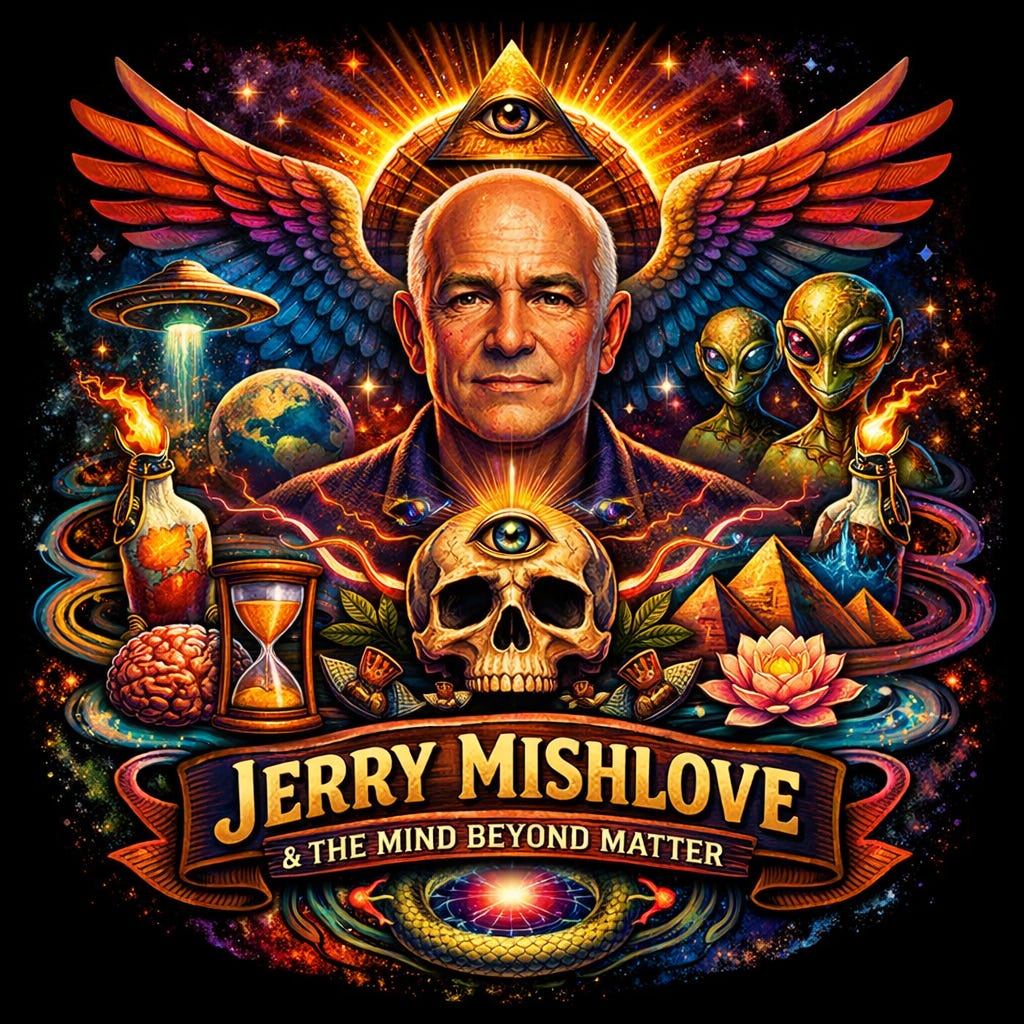
Jerry Mishlove and the Mind Beyond Matter
How One Man Turned Consciousness Into a Frontier Science Wouldn’t Touch

Jeffrey (Jerry) Mishlove’s core ideas orbit one enormous, radioactive claim,
Consciousness is not produced by the brain — it pre‑exists it, flows through it, and survives it.
Everything else he talks about is a branch off that trunk.
Here’s the clean, high impact breakdown you can use in your article, the stuff that makes him fascinating, controversial, and myth worthy.
Mishlove argues that the brain doesn’t generate consciousness, it filters, channels, or translates it.
Like a radio tuning into a signal that already exists.
This flips neuroscience on its head.
It means consciousness is primary, matter is secondary.
This is the idea that makes materialists foam at the mouth.
He doesn’t claim every psychic story is true, he claims enough of them are consistent, repeatable, or documented to warrant serious study.
Telepathy
Precognition
Remote viewing
Shared death experiences
Psychokinesis
Not as woo woo fantasies, but as data points in a bigger mystery.
He’s the only person in the U.S. with a doctoral degree in parapsychology, which makes him both a pioneer and an academic outlaw.
Mishlove leans into the idea that consciousness interacts with reality, not passively, but creatively.
Your mind isn’t just observing the world.
It’s shaping it.
Influencing it.
Bending probability around intention.
This is where he overlaps with quantum weirdness, mystical traditions, and the edges of psychology.
Dream visitations, near death experiences, synchronicities, Mishlove treats these not as hallucinations but as valid forms of knowledge.
He believes subjective experience can reveal truths that objective science can’t reach.
This is why people resonate with him,
He gives language to the strange things they’ve felt but never understood.
Mishlove’s worldview is ultimately optimistic,
Humans are capable of far more than society, science, or culture allows.
He sees consciousness as a frontier, not a puzzle to be solved, but a territory to be explored.
There are people who study the mind, and then there are the lunatics, mystics, and academic outlaws who go spelunking into the psychic underworld with nothing but a notebook and a half burnt sense of curiosity. Jerry Mishlove belongs to the second category, the rare breed of intellectual who looked at the polite, fluorescent lit halls of mainstream psychology and said, No thanks, I’ll take the abyss.
While the rest of the scientific establishment was busy dissecting rats and worshipping at the altar of materialism, Mishlove was out there chasing dreams that bled into waking life, interviewing UFO summoners, and treating psychic phenomena like legitimate data instead of cocktail party hallucinations. He wasn’t running from the weird, he was running toward it, full tilt, like a man convinced the truth was hiding in the shadows just beyond the reach of respectable science.
And that’s the thing about Mishlove, he didn’t just cross the line between psychology and mysticism, he erased it. He walked straight off the map and kept going, deeper and deeper, until the world behind him shrank into a polite little dot. He’s the only licensed parapsychologist in America, which is a bit like being the only sober man in a casino at 3 a.m., you see everything too clearly, and none of it makes sense unless you’re willing to admit the house is rigged.
Mishlove’s entire career is a middle finger to the idea that consciousness is just brain meat electricity. He talks about the mind like it’s a rogue wave crashing through the universe, something older and stranger than neurons could ever explain. And the wild part? He says it calmly. Softly. Like a man describing the weather while the rest of us are clinging to the wreckage of our worldview.
This is where the story begins, with a man who refused to bow to the tyranny of the material world, who treated dreams as messages, psychic events as clues, and consciousness as the last frontier worth fighting for. A man who didn’t just question reality, he interrogated it with a flashlight and a grin.
Trying to summarize Jerry Mishlove’s worldview is like trying to bottle a thunderstorm. The man doesn’t “have ideas”, he has detonations. He talks about consciousness the way a war correspondent talks about landmines, with awe, fear, and the faint suspicion that one wrong step might blow the whole damn paradigm sky high.
While the respectable scientists were busy worshipping their fMRI machines like golden calves, Mishlove was out there whispering the heresy that consciousness isn’t some neurological by product, it’s the source code. The primordial fire. The thing behind the thing. According to him, the brain isn’t a generator at all, it’s a filter, a cheap motel radio tuning into a cosmic broadcast that’s been playing since before the Big Bang had a name.
This is the kind of idea that makes materialists break out in hives.
This is the kind of idea that gets you quietly uninvited from faculty dinners.
But Mishlove didn’t stop there. Oh no. He marched straight into the psychic minefield and started collecting evidence like a man convinced the universe had left him a trail of breadcrumbs. Telepathy, precognition, remote viewing, shared death experiences, all the stuff polite society laughs off as hallucinations or late‑night Reddit posts. Mishlove treated them like data points, clues in a cosmic detective story that everyone else was too cowardly to investigate.
And the wildest part? He did it sober. Calm. Gentle. Like a librarian explaining overdue fees while casually dismantling the foundations of Western science.
To Mishlove, the universe isn’t a dead machine grinding through meaningless physics. It’s participatory, alive, responsive, bending probability around intention like a drunk contortionist. Your thoughts aren’t just private noise, they’re levers. Switches. Tools for shaping the world in ways the textbooks refuse to acknowledge.
He believes mystical experiences aren’t delusions, they’re messages.
He believes psychic events aren’t glitches, they’re features.
He believes human potential isn’t limited, it’s criminally underused.
And that’s why he’s dangerous.
Not because he’s wrong, but because he might be right.
Mishlove’s ideas don’t just challenge the system, they expose it. They reveal how small, brittle, and terrified the materialist worldview really is. They remind you that reality is stranger than the lab coat crowd will ever admit, and that consciousness might be the biggest, wildest frontier left.
This is the gospel according to Jerry Mishlove,
The mind is not trapped in matter.
Matter is trapped in the mind.
This is a very Interesting interview by The Why Files, this is where I did a part of my research for this article.
Jerry Mishlove, a man who didn’t just study consciousness but lived like someone who’d seen behind the curtain and couldn’t unsee it. Most academics spend their lives polishing theories like nervous jewelers. Mishlove lived his like a man who’d been handed a backstage pass to the universe and decided to wander into every forbidden room.
His story doesn’t unfold like a career, it unravels like a fever dream. One minute he’s a clean cut psychology student, the next he’s having dreams that hijack his life trajectory, dragging him into parapsychology like some cosmic prankster grabbed him by the collar and said, “You’re coming with me, kid.” And he went. Not reluctantly, willingly. Like a man who’d been waiting for the universe to finally speak up.
Most people get one mystical experience and spend the rest of their lives trying to rationalize it away. Mishlove treated his as instructions. He followed them with the reckless obedience of a man who understood that reality occasionally drops breadcrumbs, and only fools ignore them. He chased synchronicities across state lines. He interviewed psychic outlaws in motel rooms that smelled like mildew and cosmic dread. He sat with inventors, mystics, and self proclaimed alien intermediaries, not as a skeptic or a believer, but as a cartographer of the impossible.
And here’s the thing no one ever says out loud:
Jerry Mishlove is dangerous because he’s calm.
He talks about the paranormal the way a surgeon talks about anatomy, precise, measured, almost tender. There’s no mania, no theatrics, no wild eyed ranting. Just a man who has seen too much to pretend the world is small.
That’s what makes him terrifying to the establishment.
Not the ideas, the composure.
A lunatic is easy to dismiss.
A gentle man with impeccable credentials who tells you consciousness survives death?
That’s a problem.
Mishlove’s life reads like a classified file smuggled out of a government archive:
dreams that predict turning points,
encounters with people who bend probability,
a career built on the edges of what science refuses to touch.
He didn’t just cross the boundary between psychology and mysticism, he dissolved it. He became the bridge. The living contradiction. The scholar who walked into the wilderness of the mind and came back with stories that make the materialists sweat through their lab coats.
And the strangest part?
He never acts like he’s doing anything extraordinary.
He speaks softly, like a man describing the weather on a planet only he has visited.
This is the gravitational pull of Jerry Mishlove,
He makes the impossible sound reasonable,
the mystical sound empirical,
the universe sound alive.
He is the quiet revolutionary, the man who didn’t shout, didn’t rage, didn’t proselytize.
He simply kept following the trail of the inexplicable until it led him somewhere no map had ever marked.
And now you’re following him too.
Most people tiptoe around the subject of death like it’s a sleeping dog that might wake up and bite them. Not Jerry Mishlove. He walks right up to the damn thing, taps it on the forehead, and asks for an interview. And the terrifying part? He talks about survival after death with the calm certainty of a man who’s already read the last chapter of the book and refuses to spoil the ending for the rest of us.
To Mishlove, death isn’t a wall, it’s a membrane. A thin, permeable film separating one mode of consciousness from another, like slipping from waking into a dream so vivid you forget which side is real. He doesn’t treat near death experiences, apparitions, or shared death visions as hallucinations. He treats them like dispatches, postcards from the other side of the veil, written in the shaky handwriting of people who’ve seen too much.
And here’s the part that would make a neuroscientist choke on their grant money:
Mishlove believes consciousness doesn’t just survive death, it expects to.
It’s built for it.
It’s the default setting.
The body is the temporary housing.
The mind is the tenant.
And death is just the lease expiring.
He talks about it with that eerie, librarian calm tone of his, describing cases where people float out of their bodies, watch surgeons crack open their ribs, then return with details no anesthetized brain should ever have access to. He recounts stories of dying people who see dead relatives waiting for them like airport greeters. He talks about shared death experiences, where the living get pulled into the dying person’s transition, like hitchhikers catching a ride on the soul’s escape velocity.
Most academics would rather swallow a live grenade than touch this stuff.
Mishlove dives into it like a man searching for pearls in a shark tank.
And here’s the thing no one else says,
He doesn’t sound crazy.
He sounds inevitable.
He frames death not as annihilation but as migration, consciousness slipping out of the body like a snake shedding its skin, moving into a wider field of awareness where the rules are different, looser, stranger. He talks about reincarnation cases with the same tone you’d use to describe a weather pattern. He treats mediumship like a form of long distance communication. He sees the afterlife not as a fantasy but as a continuum.
To Mishlove, the universe is a vast, conscious ocean, and we’re just temporary whirlpools pretending to be separate.
Death doesn’t end the whirlpool.
It just lets the water go home.
This is the part of his work that scares people the most, not because it’s absurd, but because it’s plausible. Because if consciousness survives death, then everything we’ve built our lives around, fear, ambition, identity, the frantic scramble for meaning, starts to look like a bad joke told by a nervous species afraid of its own shadow.
Mishlove isn’t selling comfort.
He’s selling perspective.
And once you hear him out, even halfway, you start to suspect he might be right, that death isn’t the end of the story, just the end of the chapter. Before anyone starts foaming at the mouth and calling Jerry Mishlove a mystic, a crank, or some desert fried guru whispering to the void, let’s get one thing straight,
the man had credentials, real ones, the kind that make academics sweat through their tweed jackets.
This wasn’t some barefoot prophet scribbling revelations on napkins.
This was a man who walked straight into the heart of the academic machine, earned their badges, mastered their language, and then used it to expose the cracks in their precious worldview.
Here’s the part the skeptics choke on,
Jerry Mishlove’s Credentials (the ones they don’t want you to know about)
PhD in Parapsychology from the University of California, Berkeley,
the only person in the United States to ever earn such a degree.
Not honorary. Not fringe. Not from some mail‑order cult.
UC. Berkeley.
The academic Vatican of the West Coast.Master’s degree in Criminology
He didn’t start in the clouds. He started in the grit, deviance, human behavior, the dark corners of the psyche.Bachelor’s degree in Psychology
The foundation. The baseline. The conventional training he later detonated from the inside.Host of “Thinking Allowed”
A long running, academically respected interview series where he spoke with Nobel laureates, physicists, psychologists, mystics, and renegades.
Not a YouTube sideshow, a decades long archive of intellectual heavyweights.Former President of the Parapsychological Association
An organization affiliated with the American Association for the Advancement of Science.
Translation: not a cult, not a fringe club, a scientific body recognized by the same establishment that pretends he doesn’t exist.Author of award‑winning books on human potential, psi research, and consciousness studies.
This is not the resume of a quack.
This is the resume of a man who beat the system at its own game.
And that’s why they hated him.
Because Mishlove didn’t come from the margins, he came from the center.
He earned the degrees, passed the exams, shook the right hands, and then had the audacity to say,
“The mind is bigger than the brain, and your worldview is too small.”
He wasn’t an outsider throwing rocks at the castle.
He was a man who walked through the front gate, climbed the tower, and hung a flag that said,
REALITY IS STRANGER THAN YOU’RE ALLOWED TO ADMIT.
That’s what makes him dangerous.
Not the ideas, the legitimacy.
He had the paperwork.
He had the pedigree.
He had the institutional blessing.
And he still chose the frontier.If you’ve made it this far and you’re still treating Jerry Mishlove like some fringe mystic babbling into the cosmic wind, then you haven’t been paying attention. This isn’t a man you stumble across — he’s a man you study. A man you follow the way early explorers followed strange stars: not because they were safe, but because they were true.
Mishlove is one of the last intellectuals who didn’t sell his soul to the algorithmic circus. He didn’t chase fame, didn’t build a cult, didn’t turn his ideas into a self help empire. He just kept digging, quietly, relentlessly, into the deepest question a human being can ask,
What happens to consciousness when the lights go out?
And he did it with credentials, discipline, and a level of intellectual honesty that would make most academics break out in stress rashes. He’s not a guru. He’s not a prophet. He’s a scholar of the impossible, a man who walked into the forbidden wing of human experience and came back with notes instead of hallucinations.
If you care about the mind, the soul, the afterlife, the paranormal, the mystical, the scientific, the philosophical, hell, if you care about anything beyond your next dopamine hit, you owe it to yourself to look into his work.
Start with his interviews.
Watch him dismantle the materialist worldview with a smile.
Watch him talk to physicists, mystics, inventors, and psychic outlaws like he’s hosting a dinner party at the edge of reality.
Then read his books.
Not because they’ll give you answers, but because they’ll give you better questions.
Mishlove is the antidote to the intellectual cowardice of our era.
He’s the quiet revolutionary.
The man who didn’t shout, didn’t rage, didn’t preach, he just kept following the truth wherever it led, even when it wandered off the map.
If you want to understand consciousness, death, the mind, the universe, or your own strange place in all of it, then look into Jerry Mishlove.
Not tomorrow.
Not someday.
Now.
Because once the world finally catches up to him, you’ll want to be one of the people who can say you saw the frontier before the tour buses arrived.If this piece hit you — if it made your brain spark or your worldview twitch — then don’t just close the tab and drift back into the algorithmic swamp.
Become a paid subscriber.
Not out of charity.
Not out of fandom.
But because this is the kind of work I can only keep doing if the people who value it step up and back it.
If you want more writing like this, deeper, stranger, sharper, unfiltered, then hit the button and join the people who actually keep this thing alive.
Your move.
Regards,
Patrick M
This is amazing! I feel like I’ve been waiting my whole life to read something like this. Blending psychology and mysticism with a strong backing … amazing!