
Syd Barrett
The Mind behind Pink Floyd.

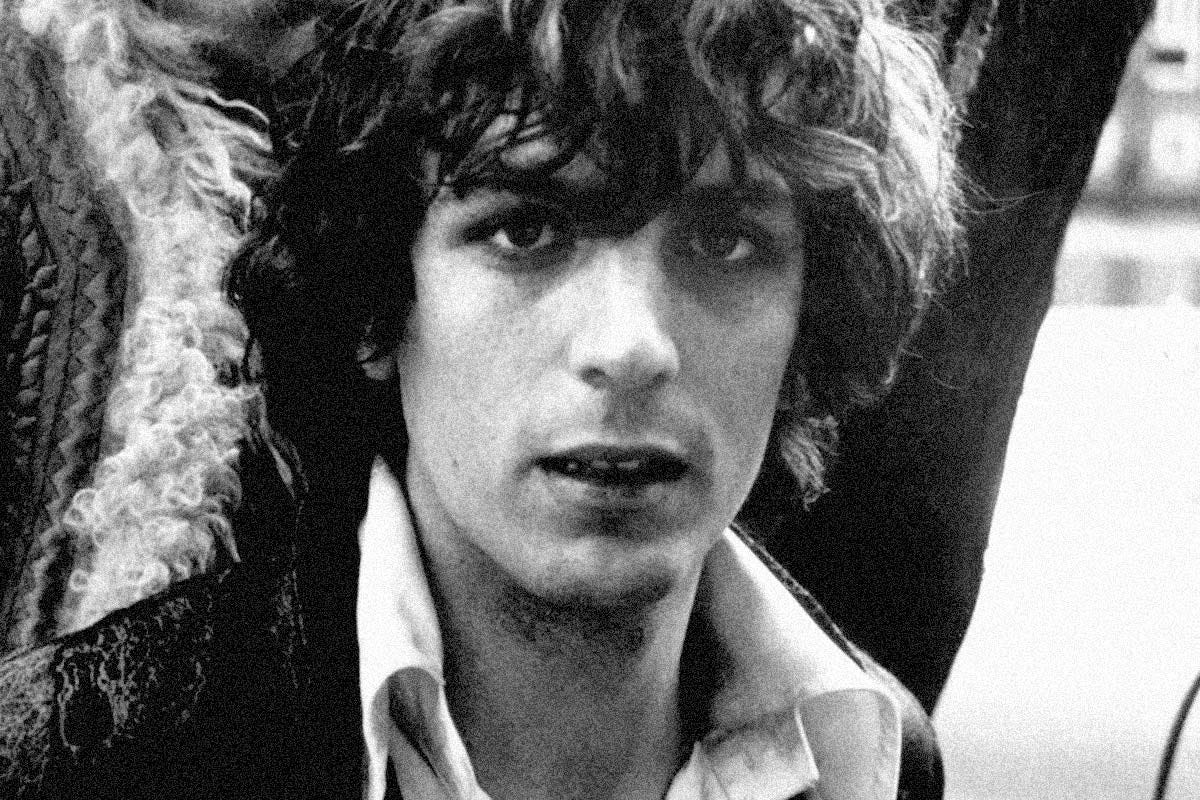
Roger Keith Barrett came screaming into this world on January 6th, 1946, Cambridge, England, a cold little island of academia and quiet madness. He was the fourth of too many children, born into a house where the walls hummed with books, microscopes, and the low grade electricity of people who think too much.
His father, Arthur Max Barrett, wasn’t just a pathologist, he was the sort of man who could stare into the meat of the human condition and call it science. A calm dissector of the mortal coil. Meanwhile his mother, Winifred, ran the place like creativity was oxygen, not a hobby, not a pastime, but a mandatory survival instinct. In that house, imagination wasn’t encouraged, it was enforced. A requirement. A law of nature.
And somewhere in that strange collision, the scalpel and the sketchbook, the microscope and the wild eyed muse, Syd Barrett began to form. A quiet boy with a fuse already lit.
Roger was one of those terrifying children who picked up instruments the way other kids picked up head colds. Ukulele at ten, banjo at twelve, guitar at fourteen, a steady escalation of string based weaponry, like he was preparing for some future musical coup. Most kids that age were busy setting fire to plastic soldiers or discovering the dark arts of bubblegum theft, but not Roger. No, he was already assembling the early components of a one man creative insurgency.
And as if that wasn’t enough, the boy wrote poetry, award winning poetry, the kind that made teachers whisper things like “gifted” and “strange” in the same breath. He painted, too. Drew obsessively. The kid was a walking arts department, a whole damn curriculum stuffed into one skinny Cambridge body.
He wasn’t a one talent wonder, he was a hydra of creativity. Chop off one artistic head and two more would sprout, one holding a paintbrush, the other tuning a guitar. The question was never if he’d do something remarkable. It was when, and how many people would be left standing after the blast radius of his imagination finally detonated.
Even then, you could sense it, the quiet hum of destiny, the eerie glow behind the eyes. Roger Barrett wasn’t just promising. He was a loaded gun left on the table, waiting for the universe to pick it up and pull the trigger.
On December 11th, 1961, less than a month before his sixteenth birthday, the universe took a swing at young Roger Barrett and didn’t miss. His father died of cancer, and the whole damn world tilted sideways. And what did Roger do? The boy who filled every inch of every page with poems, sketches, doodles, cosmic nonsense, and whatever else his brain was leaking that day… left the diary entry completely blank.
A white void. A silent scream. A page so empty it practically glowed.
Most teenagers would’ve written something dramatic, a tortured paragraph, a bad poem, maybe a drawing of a skull smoking a cigarette. But not Roger. No, he looked at the worst day of his life and decided it didn’t deserve ink. Didn’t deserve shape. Didn’t deserve the dignity of language.
It was the kind of blank that wasn’t empty at all, it was overloaded, like a circuit fried by too much voltage. A psychic blackout. A kid staring into the abyss and choosing not to take notes.
And honestly, that’s the most Syd Barrett thing imaginable, when reality becomes unbearable, he simply refuses to document it. He erases it by omission. A quiet act of rebellion against the universe itself.
A blank page as a middle finger to fate.
Roger threw together a band the way other boys threw together trouble, fast, loud, and with absolutely no regard for the structural integrity of the household. His mother, saintly or deranged depending on the hour, let the whole circus rehearse in the front room. Amplifiers buzzing, strings snapping, teenage egos colliding like drunk bumper cars. The neighbors probably thought the Barretts were running an experimental noise torture program for the Ministry of Defence.
And then there was Roger Waters, lanky schoolmate, professional observer, future usurper, drifting into the Barrett home to watch the chaos unfold. His mother had been Syd’s primary school teacher, which already made the whole thing feel like some cosmic prank. Nobody in that room, not even the gods, had the faintest idea that this quiet kid leaning in the doorway would one day replace the very boy he was admiring. Fate has a sick sense of humor.
But let’s not pretend Waters was some benevolent spirit floating through the Barrett living room. No, he was already radiating that peculiar brand of intensity that makes you check your pockets and count your blessings. And don’t get me started on Roger Waters. The man is a walking diplomatic incident. A human thundercloud. A one man Cold War. An absolute piece of work in the cosmic sense, the kind of guy who could start an argument in an empty room and still walk out feeling victorious.
Yet there they were, two Rogers, two futures, one front room vibrating like a UFO landing pad. Nobody knew what was coming. Nobody could. That’s the beauty of it, the whole mad saga beginning in a suburban living room, with guitars out of tune, teenage dreams out of proportion, and destiny quietly sharpening its teeth in the corner.
Nobody in that cramped suburban living room had the faintest clue they were watching the embryonic twitchings of what would become Pink Floyd, the future psychedelic war machine still in its larval stage, buzzing faintly under the wallpaper. History never announces itself, it just sits in the corner, smoking quietly, waiting for everyone to catch up.
By fourteen, Roger had somehow acquired the nickname S.Y.D, spelled like a code name, spoken like a rumor. His sister Rosemary swore he was never “Syd” at home. At home he was just Roger, a polite, peculiar boy with too many ideas and not enough hours in the day. But outside? Outside he was building a character, brick by brick, like a teenage Dr. Frankenstein stitching together a persona from spare parts and cosmic debris.
And that’s the trouble with inventing a character, sooner or later you have to decide which one is actually you. The quiet boy from Cambridge or the electric phantom with the three letter name. The mask or the face beneath it. Most people never face that question. Syd Barrett walked straight into it like a man stepping off a cliff because he wanted to see what falling felt like.
The world saw “Syd.”
The family saw “Roger.”
And somewhere in the middle, the real one started to flicker.
By 1964, Barrett blasted out of Cambridge and hurled himself into London, the great cultural meat grinder of the era, allegedly to study painting at Camberwell College, though God knows how much studying actually happened. London in ’64 was a swirling psychedelic soup, and Syd dove in headfirst, paintbrush in one hand, guitar in the other, destiny chewing on his shoelaces.
Somewhere in that chaos he reconnected with Roger Waters, who had also migrated to the capital like a man fleeing a small town curse. Waters had formed a band, a deeply unremarkable outfit called The Tea Set, which sounded less like a rock group and more like something your grandmother collects in a glass cabinet. They hammered out R&B covers with all the enthusiasm of a group of teenagers trying to impress girls who weren’t paying attention. Nobody was writing home about them. Nobody was writing anything about them.
Then Barrett walked in.
And suddenly the whole operation lurched sideways into the unknown. Syd didn’t just join the band, he detonated inside it. He started writing songs that sounded like nothing anyone had ever heard, like transmissions from a parallel universe where the laws of physics were optional and melody was a controlled substance. The Tea Set went from a forgettable pub act to a strange, shimmering creature with teeth.
It was the moment the universe quietly shifted its weight.
The moment the ground under London began to hum.
The moment the future Pink Floyd started to crawl out of the primordial ooze.
And none of them, not Waters, not Barrett, not the baffled audience, had the slightest idea what kind of monster they were waking up.
Barrett didn’t just bring songs, he brought the name, the whole damn identity. While everyone else was fumbling around with half baked band titles that sounded like failed pub quizzes, Syd reached into the dusty attic of American blues and stitched together a monster. Pink Anderson. Floyd Council. Two ghosts from the Delta mashed together like some psychedelic Frankenstein experiment, and suddenly, Pink Floyd.
A name born from a 20 year old art student sitting in a cluttered London flat, probably surrounded by paint fumes, cigarette ash, and the kind of creative mania that makes normal people nervous. Nobody could’ve guessed that this improvised blues fusion name would eventually be stamped on a quarter of a billion records. That’s not a band name, that’s a global hallucination.
By 1966, Pink Floyd had become the house band of London’s psychedelic underground, the unofficial soundtrack to every acid soaked basement, smoke choked club, and neon lit fever dream in the city. They weren’t just playing music, they were conducting experiments on the human nervous system.
And Syd… Jesus. Syd was out there making sounds that shouldn’t exist. He’d slide a Zippo lighter down the fretboard like he was trying to saw the guitar in half, then feed the whole mess through an echo box until it screamed, shimmered, and mutated into something that felt less like music and more like a transmission from a distant, chemically unstable planet.
People didn’t know whether to dance, run, or call an exorcist.
But that was the magic, Syd Barrett wasn’t playing the guitar, he was summoning it. Conjuring noises that defied physics, common sense, and every safety regulation known to man.
The band brought the amps.
Syd brought the madness.
And the rest is the kind of history that still rattles the walls.
Barrett took his first hit of LSD in 1965, a casual little chemical handshake with the void, and by ’67 he was reportedly dropping it like vitamins. Breakfast, lunch, and spiritual annihilation. This is the point in the story where everything stops being biography and starts sounding like a police report written by a hallucinating witness.
He was living in a flat with a pair of human landmines known as Mad Sue and Mad Jock, which already tells you everything you need to know about the structural integrity of the situation. Some sources claim his morning tea was being spiked with LSD without his knowledge, a horrifying thought, like discovering your cereal has been seasoned with plutonium. Whether it happened once, twice, or every damned day has never been proven. The whole thing sits in that murky swamp between rumor and tragedy, where the truth floats face down and nobody wants to flip it over.
But the effects were visible. People said Barrett started to look vacant, not spaced out in the fun, cosmic tourist way, but hollowed out, like someone had reached into his skull and flicked off the main breaker. His eyes went black and bottomless, the kind of eyes that make you wonder if the person behind them has stepped out for a smoke and forgotten to come back. He grew gaunt, ghostly, a shadow of the incandescent creature he’d been just a year before.
It wasn’t the look of a man who’d taken too many drugs.
It was the look of a man who’d been ambushed by the universe.
And the universe, as usual, didn’t leave a forwarding address.
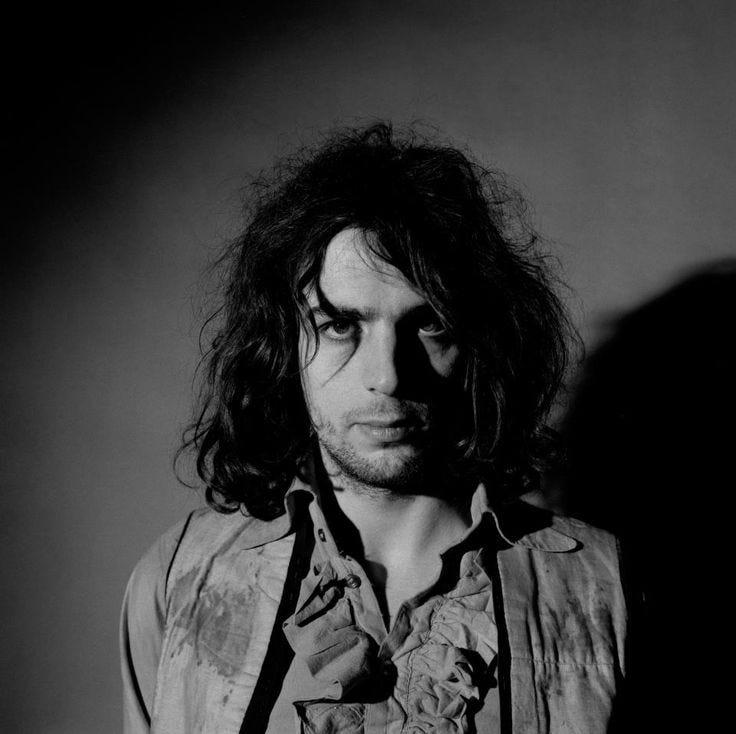
Some people say the LSD cracked something open in Barrett’s mind, maybe schizophrenia, maybe some dormant cosmic parasite waiting for its cue, but nobody knows a damn thing for sure. Theories fly around like drunk pigeons, but the only thing anyone can agree on is the timeline, and that’s grim enough without the armchair psychiatry.
In 1966, Syd Barrett was the most electrifying young musician in London, a human spark plug, a psychedelic prodigy, the kind of creative force that made other artists reconsider their career choices. He was incandescent, unpredictable, and frighteningly original. You could feel the voltage coming off him like heat from a reactor core.
By the end of 1967, he couldn’t function.
That’s the brutal truth. No poetry, no mystique, no romanticized acid casualty nonsense. One year he was rewriting the laws of music, the next he was staring through people like they were made of smoke. It was as if the universe had reached down, flipped a switch in his skull, and walked away whistling.
People argue about diagnoses, conspiracies, chemical sabotage, and cosmic destiny, but the timeline doesn’t argue.
The timeline just sits there, cold and merciless, like a police report stamped CASE CLOSED.
And this is where the whole thing finally buckled. Barrett wasn’t just struggling, he was slipping through the cracks of his own legend. One day he was the incandescent nucleus of the most dangerous band in London, and the next he was wandering onstage like a man who’d misplaced his own name. Gigs turned into coin flips. Sometimes he’d play like a prophet with a guitar made of lightning, other times he’d stand there frozen, staring into the crowd as if he’d just seen God lose a bar fight.
The band tried everything, coaxing, threats, backup plans, extra guitarists, cosmic patience, but you can’t negotiate with a mind that’s already halfway out the door. Barrett wasn’t malfunctioning. He was departing. Slipping into some private dimension where the rest of us weren’t invited.
By late ’67, the decline wasn’t a rumor. It was a landslide. The same people who’d once sworn he was the future of British music now whispered that he couldn’t function, couldn’t focus, couldn’t even find the thread of his own songs. It was like watching a star collapse in real time, brilliant, terrifying, inevitable.
And that’s the tragedy of Syd Barrett,
He didn’t burn out.
He evaporated.
One moment he was the brightest young mind in London, bending sound into impossible shapes, dragging music into the future by sheer force of imagination. The next, he was gone, not dead, not destroyed, just… unreachable. A ghost wandering the edges of his own story.
The band moved on. The world moved on. But Barrett drifted into the long, quiet aftermath, a man who had once opened doors no one else could see, now living in the shadow of the very universe he’d helped create.
In the end, Syd Barrett didn’t fall from grace.
He simply stepped sideways out of reality,
and never bothered to come back.
If you enjoyed this and want more deep dive stories like it, do me a favour, leave a comment, restack it, or share it with someone who’d get a kick out of it. It helps more than you think.
And if you want to support the work directly, consider subscribing, or even becoming a paid subscriber if you’re feeling generous. It keeps the lights on, keeps the stories coming, and keeps me from having to sell stuff on Marketplace again.
Thanks for reading. Really.
Regards,
Patrick M
There’s something deeply unsettling in Syd Barrett’s story because it never feels like a simple rise and fall. It feels more like watching someone open a door too early, step through it completely, and then lose the path back to ordinary reality.
What remains extraordinary is that even after he disappeared from the center of Pink Floyd, his absence kept shaping the music like a hidden gravity. “Wish You Were Here” doesn’t just remember a musician. It remembers a presence that altered everyone around it.
Loved him.