

There is no A.I.
Inspired by someone else's article

Jaron Lanier, that wild‑haired digital mystic, is introduced by the New Yorker as a “computer scientist, author, and musician,” which is a polite way of saying he’s one of those polymathic freaks who wandered out of the early tech frontier with a flute in one hand and a manifesto in the other. Wikipedia, in its usual bureaucratic sprawl, calls him an “American computer scientist, visual artist, computer philosophy writer, technologist, futurist, and composer of contemporary classical music.” In other words, a full spectrum human hallucination. A man who seems to have lived six parallel lives and taken notes in all of them.
He wrote Who Owns the Future? and Ten Arguments for Deleting Your Social Media Accounts Right Now, which already tells you he’s the kind of guy who sees the digital world not as a playground but as a malfunctioning carnival ride operated by drunk billionaires.
In his first piece for the magazin, bold, twitchy, philosophical, the kind of thing you read with your shoulders slightly hunche, Lanier insists that A.I. is not some shimmering alien intelligence descending from the cloud, but a tool, a glorified mirror held up to humanity’s collective noise. No ghosts in the machine. No techno shamanic spirits. Just us, reflected back with unsettling clarity.
And then he drops his real bomb, “data dignity.” A human first doctrine. A demand that the people feeding the machine, every post, every photo, every stray thought, should be credited, compensated, acknowledged. Not strip mined. Not harvested like digital livestock. Paid.
It’s worth reading the whole thing, preferably with a stiff drink and a suspicious eye toward every glowing screen in the room. Here are a few volatile fragments, bytes, as he’d say, still smoking from the blast.
When you corner the most terrified scientists, the ones who’ve been staring too long into the digital abyss, and ask them to explain how the Great A.I. Doom might actually unfold, they don’t give you answers. They freeze. Their eyes glaze over like they’ve just glimpsed the raw machinery of God. They mutter things like, “Accelerating progress will fly past us and we won’t be able to conceive of what is happening,” which is the academic way of saying the future will hit us like a freight train and we’ll be too stunned to scream.
And sure, the Internet is crawling with claims that half of A.I. researchers believe extinction is on the menu, Lanier cites that statistic himself, but try getting any of these doomsday prophets to explain the mechanism. The how. The chain of events. You’ll get nothing but cosmic dread and sweaty silence. Meanwhile, the longtermist crowd, MacAskill and his apocalypse accountants are busy shoveling all their moral energy into A.G.I. fear mongering, treating inequality, climate change, and every other real‑world crisis like background noise in the prelude to Armageddon.
Lanier’s counterpunch is simple, almost offensively sane, A.I. is a tool, not a creature. A hammer, not a god. A mirror, not a mind. And that doesn’t mean we’re safe humans can misuse any tool badly enough to wipe themselves out. But the danger comes from our own incompetence, not from some mythical machine consciousness rising up like a vengeful spirit.
The real poison, he argues, is mythologizing the tech, treating it like a sentient oracle, a digital messiah, a lurking demon. That kind of thinking makes us stupid. It narrows our imagination. It shackles us to yesterday’s sci fi hallucinations. The sooner we understand that “A.I.” is just a marketing term for a pile of statistical tricks, the sooner we can start managing it with actual intelligence instead of techno religious panic.
Lanier is swinging at the inevitability fallacy, the cultish belief that technology marches toward a single predetermined fate. He’s reminding us that we still have agency, that the steering wheel is in our hands, even if the road is foggy and the car is missing a few bolts.
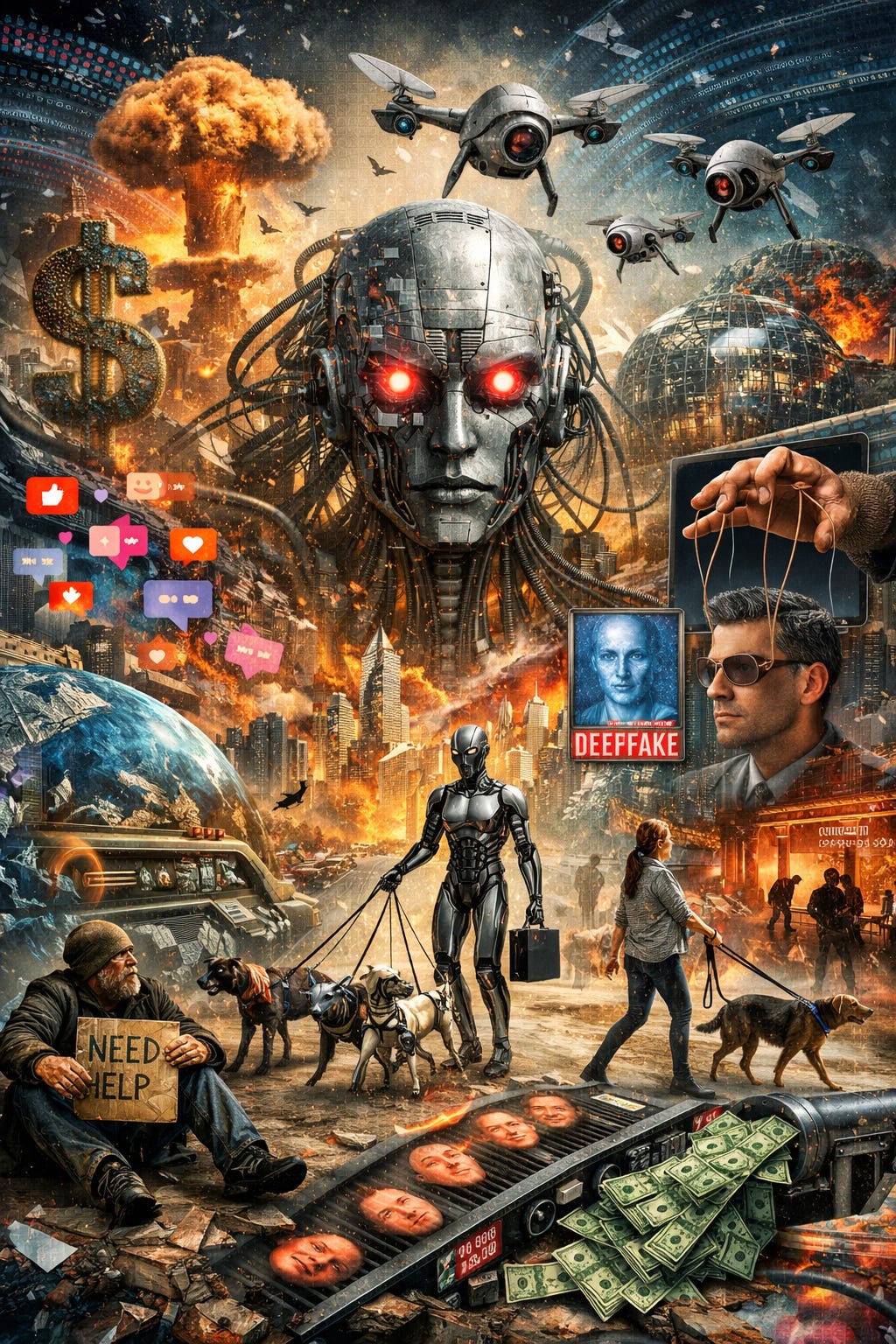
And he’s right, every time we slap a robot on a magazine cover, robots strolling past homeless humans, robot dog walkers crossing paths with their flesh and blood counterparts, we’re feeding the myth. We’re turning tools into characters, algorithms into gods, and ourselves into extras in someone else’s dystopia.
It’s the wrong way to think about artificial intelligence.
It’s the wrong way to think about ourselves.
And it’s exactly how civilizations talk themselves into disasters.
Many of the so called “uses of A.I.” that actually feel good, humane, sane, not cooked up in some corporate war room, come from the simple miracle of machines finally loosening their damned rigidity. For decades, digital tech has been a brittle, plastic tyrant, forcing humans to contort themselves into whatever shape the interface demanded. You’ve seen it, some poor bastard at a doctor’s office, sweating bullets as he tries to appease the front desk touchscreen. His face twists, his dignity evaporates, and the machine, cold, unblinking, demands obedience. This is the quiet violence of the digital age, an ambient expectation that humans must bow to the software.
Lanier’s hopeful twist is that A.I., if we don’t screw it up, might finally end this torture. Imagine a website that reshapes itself instantly for a color blind user, or one that adapts to someone’s cognitive quirks instead of punishing them. A humanist’s dream, technology bending toward people instead of people breaking themselves against technology. Flexibility as liberation. A small return of agency in a world that’s been draining it like a leaky radiator.
This whole vision echoes the ghost of Mark Weiser, the Xerox PARC wizard who believed computers should melt into the background and quietly enhance human life. In John Tinnell’s The Philosopher of Palo Alto, Weiser imagines a world where your alarm clock and coffee pot conspire to get you out the door on time, where blinds and lights shift themselves to save energy without making you feel like you’re living inside a corporate panopticon. Data collected not to sell you sneakers, but to make your morning less hellish.
But that future never arrived. Instead, the corporate machine latched onto the PC, those inflexible digital monoliths, and marched straight into surveillance capitalism. The dream of adaptive, humane computing was gutted and replaced with profit driven digital assistants that smile while they spy on you.
Lanier’s point is clear, A.I. could give us back some control, but only if we stop treating it like a deity and start treating it like a tool. Otherwise we’re just feeding another behemoth that will happily grind us into compliance.
Privacy. Christ. I spent years wading through the bureaucratic swamps of the E.U., trying to pin down this slippery bastard of a concept, and the truth is we don’t know what it is. We talk about “privacy” like it’s a solid object, something you can hold, defend, legislate, but try to define it and the whole thing melts into your hands like warm wax. The closest anyone’s come is “the right to be left alone,” which now sounds like a joke in an era where every waking moment depends on some digital pipeline feeding you services, dopamine, and surveillance. In the age of A.I., maybe privacy means “the right not to be manipulated by computation,” but even that feels like trying to catch a hurricane in a butterfly net.
Food for thought, or maybe for madness.
So I started calling people, colleagues, veterans, the usual suspects, and asking them if there’s anything we can all agree on in this swirling techno nightmare. Turns out there is. Everyone agrees that deepfakes, those slick, real seeming hallucinations, should be labeled. Stamped. Branded. If a machine makes it, the machine should confess. Same goes for artificial personas and automated psychological puppetry. If a bot is trying to steer your thoughts, you should know it. And you should have options, real choices, not the usual corporate illusion of choice.
But how the hell do we make that happen? The consensus is almost unanimous, the black box era of A.I. has to die. These systems need to be cracked open, made transparent, explained. But that’s like asking a jellyfish to recite Shakespeare. Large models aren’t built from ideas, they’re built from a vast, quivering ocean of mathematical jello. No desires, no labels, no tidy compartments. Just a statistical soup that occasionally spits out something that looks like intention.
Still, it’s refreshing, an antidote to the usual regulatory gobbledegook. Transparency is a simple, human idea. In journalism, we bleed for it. You never let advertisers ghost write the news. You never hide the source of information. You never intentionally mislead the reader. An unlabeled deepfake is the moral equivalent of slipping a hallucinogen into someone’s drink.
Which brings us to data dignity, the notion that your digital exhaust is actually labor, and should be treated as such. The current setup, the Big Tech arrangement, has rotted into a grotesque carnival. Network effects crown a handful of platforms as emperors, wiping out smaller players like local newspapers. And because everything online is supposed to be “free,” the only business left is influence peddling. Users wander through what looks like a communal utopia, but behind the curtain they’re being poked, prodded, and psychologically kneaded by addictive algorithms that make them vain, irritable, paranoid, perfect consumers.
In a world with data dignity, digital creations would be tied back to the humans who made them. People could get paid for their contributions, even when filtered, remixed, and chewed up by giant models. Tech hubs would earn fees for facilitating human activity, not for strip mining human behavior. Some recoil at the idea of capitalism online, but this would be an honest capitalism. The “free” model has been a disaster, Lanier says it outright, and he’s right. It killed newspapers. It turned platforms into surveillance engines. It made users into livestock.
Reddit’s CEO even said it plainly: “Crawling Reddit, generating value, and not returning any of that value to our users is something we have a problem with.” That’s data dignity in embryo, a rare moment of clarity in the digital fog.
Become a Subscriber, Join the Madness
If you’ve made it this far, you’re clearly one of the strange, beautiful few who enjoy staring directly into the electric storm of modern reality. Good. Stay with me. This whole operation runs on the fuel of people who want more than the sanitized sludge pumped out by the algorithm farms.
Hit subscribe.
Not the polite, casual kind, the full‑throttle, paid‑up, front row seat to the chaos kind.
Paid subscribers get the deeper dives, the unfiltered dispatches, the late night field notes, the stuff I don’t throw into the public square for the bots to chew on. You get the real work, the high‑voltage essays, the gonzo investigations, the myth‑making, the cultural autopsies.
If you want to help build a community of readers who aren’t afraid of thinking dangerously, who want writing with teeth, who want to push back against the digital fog, this is your moment.
Subscribe.
Upgrade.
Step inside the tent.
Let’s keep this thing loud, weird, and alive.
Regards,
Patrick M
You inspired me to be the AI that I wish to see in the world.
This deeply resonates with something I wrote before: AI is a mirror of us. It reflects our intelligence, creativity, fear, bias, cruelty, and compassion back at us. But the mirror is shaped by who builds it, what is fed into it, and who controls where it is pointed.
The real danger may not be a machine becoming human. It may be humans surrendering their agency while corporations profit from the reflection