

Why Every Online Community Eventually Turns Into a Mental Hospital.
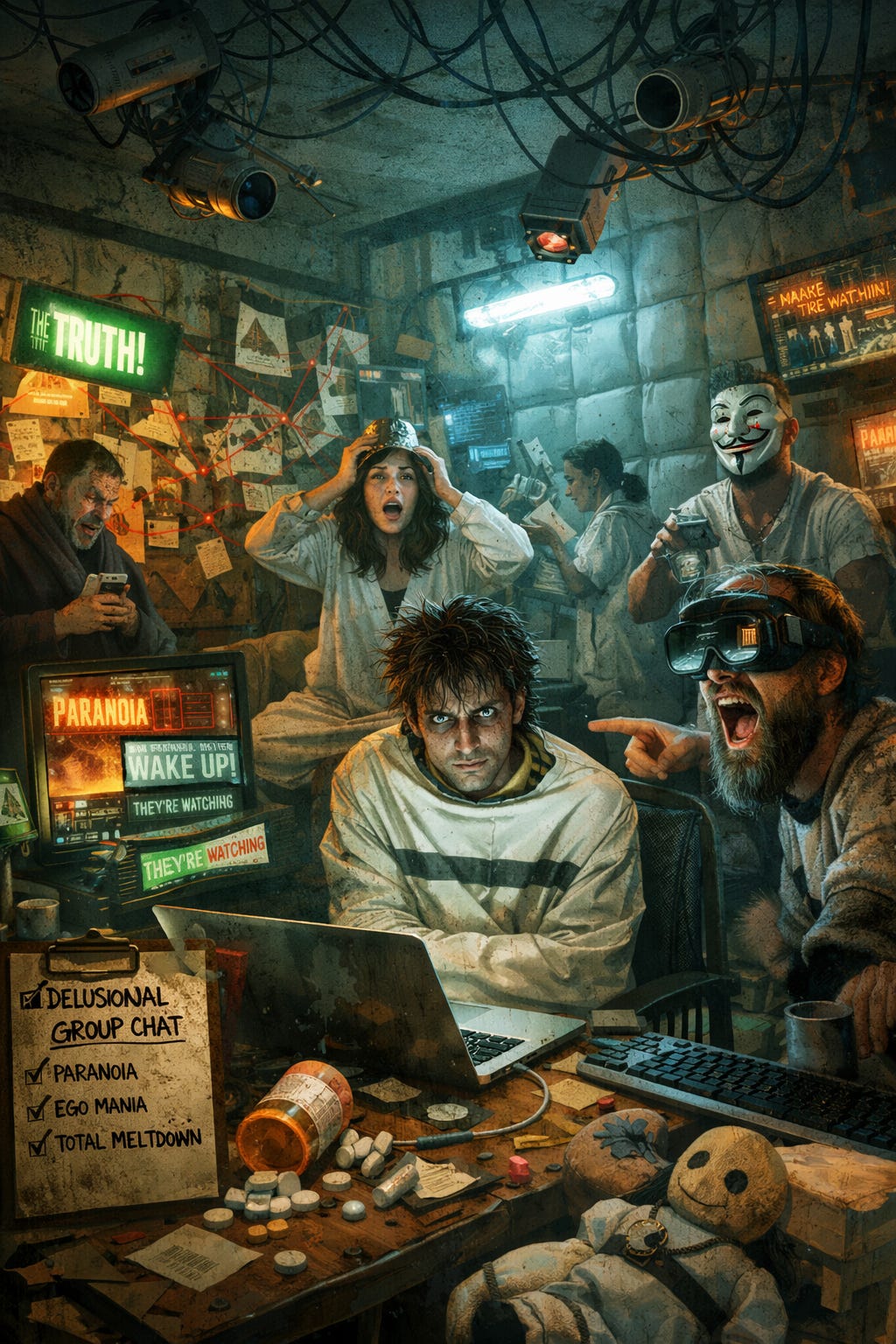
How group chats, forums, and Discord servers slowly mutate into psychiatric wards.

Every online community starts the same way, a handful of hopeful lunatics huddled around a digital campfire, convinced this time it’ll be different. This time it won’t rot. This time it won’t turn into a circus of paranoia, ego, and emotional shrapnel. This time the group chat will stay “chill.”
Give it three weeks.
The truth, the one nobody wants to say out loud, is that the internet is the world’s largest open air psych ward, and every community is just a fresh wing waiting to be filled. You can watch the madness bloom in real time, the inside jokes calcify into doctrine, the quiet ones start sharpening their grievances, and the self appointed prophets rise from the algorithmic swamp to deliver their gospel of half truths and trauma.
And the wildest part?
Everyone thinks they’re the sane one.
Online spaces don’t go insane because of trolls or drama or “bad vibes.” They go insane because the moment humans gather behind screens, something ancient and feral wakes up, a tribal instinct with no village to anchor it, no elder to calm it, no consequences to keep it from sprinting straight into the abyss.
Communities don’t collapse.
They metastasize.
And if you stay long enough, you’ll watch the transformation happen, the jokes get sharper, the tone gets stranger, the energy gets heavier, and suddenly you’re not in a community anymore, you’re in a padded room with Wi‑Fi.
It started as a wholesome little Discord server for people who liked moths.
Just moths.
Pictures of moths.
Facts about moths.
A gentle, harmless corner of the internet.
Within two months it had become a spiritual cult with a body count of deleted accounts.
At first it was cute, people naming their favorite species, sharing photos, arguing about wing patterns like normal, functioning humans. But then someone posted a blurry night vision photo of a giant shadow on their porch and said,
“I think the Moth God is real.”
That was the spark.
Suddenly half the server was convinced there was a cryptid level mega moth living in rural Ohio. The other half insisted the photo was fake and began conducting forensic analysis like they were investigating a political assassination. Mods tried to calm everyone down, but by then the madness had momentum.
People started assigning roles like “Prophet of the Cocoon” and “High Priest of the Porch Light.”
Someone wrote a 14 page manifesto about “ascending into the winged realm.”
A guy named Lenny claimed he’d been chosen by the Moth God after seeing a particularly large bogong moth at 3AM.
Then came the schism.
A faction broke off and formed a rival server called “True MothWatchers,” accusing the original group of “heresy” for allowing butterfly enthusiasts to join. The butterfly people retaliated by creating a third server dedicated to “exposing the moth supremacists.”
By month three, the original server had:
47 banned users
3 competing prophecies
2 fake sightings that caused real world arguments
and one guy who tried to start a GoFundMe to “build a shrine in the woods”
The final meltdown happened when someone discovered the original “Moth God” photo was actually a zoomed in picture of a possum.
The server imploded within hours.
Mods resigned.
Prophets renounced their visions.
People deleted their accounts like they were fleeing a crime scene.
And just like that, a community built on moth appreciation died the way all online communities die,
Not with a bang, but with a paranoid, delusional, ego‑drunk spiral into collective insanity.
The deeper you go into an online community, the more it starts to look like a digital remake of Lord of the Flies, only instead of a bunch of stranded schoolboys losing their minds on an island, it’s adults with Wi‑Fi, sleep deprivation, and unresolved childhood trauma reenacting the same ancient collapse in real time.
Every online space starts with that same fragile optimism,
We’re different. We’re enlightened. We’re here for the right reasons.
The same delusion the boys had when they blew the conch and thought they could build a society out of thin air.
But the internet is a far more dangerous island.
There’s no conch, no rules, no adult supervision, just a swirling mass of personalities waiting for the first excuse to fracture into tribes. And once the fracture happens, the transformation is immediate and feral. The jokes turn into doctrine, the quiet ones sharpen their grievances, and the loudest lunatic becomes the de facto prophet.
It’s Lord of the Flies with memes.
Piggy with a Discord account.
Jack Merridew running a group chat at 3AM, demanding loyalty oaths and threatening bans.
And the worst part?
Nobody thinks they’re part of the madness.
Everyone believes they’re Ralph, the sane one, the reasonable one, the last adult in the room, even as they sprint around the digital island with a torch, screaming about “vibes” and “energy” and “community values.”
The island always wins.
The algorithm always wins.
And sooner or later, every server, forum, and group chat ends up reenacting the same ancient human tragedy, only this time, the monsters aren’t in the jungle.
They’re in the comment section.
Here’s the uncomfortable truth nobody wants to admit,
When an online community finally snaps, when the bans pile up, when the prophecies start multiplying, when the “sightings” turn out to be a possum in disguise, and everyone flees like they’re escaping a burning building, it’s not just chaos. It’s a revelation.
Because collapse isn’t the end of the story.
Collapse is the moment the mask slips.
Every meltdown, every schism, every digital psychotic break is a flare shot into the sky revealing something ancient and human underneath all the emojis and usernames. It shows us what people really want, belonging, meaning, a tribe, a myth to cling to when the world feels too big and too fast and too indifferent.
Even the MothWatchers meltdown, the bans, the competing prophets, the fake sightings, the final possum based humiliation, was never just about moths. It was about people trying to build a tiny universe where they mattered, where their voice echoed, where their weirdness wasn’t just tolerated but celebrated. And when that universe cracked, it didn’t just expose their madness.
It exposed their hunger.
The hunger to be seen.
The hunger to be part of something.
The hunger to feel like the world makes sense, even if the sense is held together with duct tape and delusion.
And here’s the inspiring part, the part nobody talks about because it’s easier to mock the insanity than understand it,
Every online community is a failed attempt at building a new kind of village.
A digital tribe.
A modern campfire.
A place where the lonely, the brilliant, the strange, the wounded, and the terminally online gather and try , desperately , to create meaning out of the static.
Yes, it goes sideways.
Yes, it mutates into paranoia and ego and emotional shrapnel.
Yes, it ends with people sprinting for the exit like they’re escaping a crime scene.
But the attempt itself?
That’s the most human thing we do.
The madness isn’t the point.
The madness is the price of admission for trying to build connection in a world that keeps dissolving it.
If you zoom out far enough, past the 47 bans, past the competing prophecies, past the fake sightings that sparked real world arguments, past the humiliating possum reveal that detonated the whole thing in minutes, you start to see a pattern emerging from the wreckage .
A pattern older than the internet.
Older than forums, group chats, Discord servers.
Older than electricity.
Every online community that collapses is reenacting something ancient and human, a ritual as old as tribes, as old as myth, as old as the first time a group of people tried to build meaning together and accidentally summoned chaos instead.
Because here’s the revelation nobody expects,
The madness isn’t a glitch.
It’s the message.
The bans, the schisms, the prophets renouncing their visions, the mass account deletions like people fleeing a crime scene, all of it is the internet’s way of showing us the truth about ourselves .
We are not built for infinite connection.
We are not built for endless tribes.
We are not built for a world where every thought, every insecurity, every half formed identity can be broadcast, mirrored, amplified, and weaponized.
But we are built for meaning.
And that’s the paradox.
Every community that implodes is proof that people are still trying , desperately, foolishly to build a village out of pixels. To create a place where they matter. To feel less alone in a world that keeps dissolving the things that used to hold us together.
The meltdown isn’t the failure.
The meltdown is the x‑ray.
It shows us the bones of the human condition:
the longing, the fear, the ego, the hunger for belonging, the terror of insignificance, the ancient instinct to gather around a fire, even if the fire is a Discord server and the tribe is arguing about a moth that turned out to be a possum.
And here’s the real revelation, the one that hits like a cold wind,
Every online community is a rehearsal for the world we’re trying to build.
A prototype.
A sketch.
A messy, glitching simulation of the future of human connection.
Some prototypes explode.
Some mutate.
Some collapse into paranoid, delusional spirals of ego and prophecy and digital bloodshed, exactly like the moth cult meltdown did, right before the possum unmasked the whole thing .
But the attempt?
The attempt is everything.
Because buried inside every collapse is the same stubborn, defiant truth,
People still believe in each other enough to try again.
And that, in a world this fractured, this fast, this lonely, is nothing short of miraculous.
If this piece hit you in the ribs, don’t just close the tab, step inside. Subscribe and join the only corner of the internet that’s still awake.
Regards,
Patrick M.
Too funny
👏